Resources

What is Concrete Maturity?

When concrete hardens (cures), it gives off heat proportional to its curing rate. The concrete maturity method is used to account for the combined effects of time and temperature on the strength development of concrete. By learning how much heat is released, an accurate estimate of the concrete strength can be determined. Generally, concrete in a structure cures at a MUCH faster rate than concrete in a test cylinder. This is due to the much larger mass of the structure, and better hydration which aids curing. When determining the early-age strength of cast-in-place concrete, reliance on test cylinders can lead to problems. For example, if test cylinders are cured at a lower temperature than the structure, the cylinders would underestimate the strength of the slab, which means that critical construction operations are delayed unnecessarily. Or conversely, if the deck is cooler than the cylinders, the cylinders would overestimate the strength,

Read More »

Mass Concreting

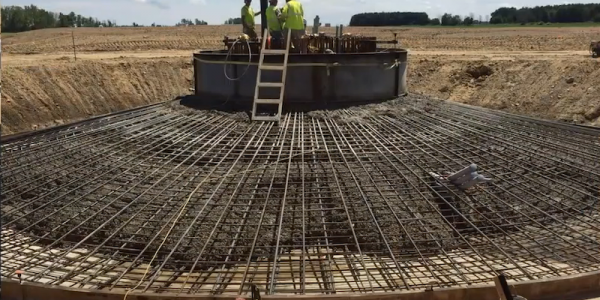
For any concrete placement larger than 4 feet across in any dimension, project specifications typically require temperature monitoring of the concrete in several locations (core, face, etc.). There are usually restrictions placed on how high the temperature can be allowed to go, and also on how much the core temperature can differ from the outside edges (the “differential”). For example, most mass concreting specifications call for an absolute maximum temperature value of not more than 160°F, and a core-to-face differential of never more than 35°F. The main reason for this degree of control is to reduce or eliminate cracking that can occur when the concrete gets too hot and the differentials are too great. It is especially important when the massive concrete is being used for things such as containment vessels or bridge piers, where even a single crack could require that the concrete be removed and replaced. From this,

Read More »

Extreme Weather

Cold Weather Concreting According to the American Concrete Institute (ACI 306R-16): “The conditions of cold weather concreting exist when the air temperature has fallen to, or is expected to fall below, 40°F (4°C) during the protection period.  The protection period is defined as the amount of time recommended to prevent concrete from being adversely affected by exposure to cold weather during construction.” In other words, concrete needs to be protected from the adverse effects of being exposed to cold temperatures for it to cure properly. When placing concrete in the cold, special precautions may need to be taken. Insulating blankets, heating mats and heated enclosures are typically used to protect concrete from damage due to low temperatures. Without these protection measures, cement hydration can be slowed, or even stopped, and drastic fluctuations in finishing and curing times may occur. If concrete freezes at an early age, it may experience permanent damage. Modifying the

Read More »

Precast Concrete

The Benefits of Maturity for the Precast Market Save enormous amounts of money on energy. Save time and labor by requiring fewer test samples to be made, cured, stored, broken and recorded. Optimize mix designs around bed strengths rather than cylinder strengths. Improve safety by never de-tensioning strand too soon. Key in on QC issues with concrete almost instantly, improving overall QC. Fix problems faster, reducing the chance of failures and re-working Reduce waiting times, improve productivity (flip beds faster) Reduce waste by never stripping too soon. How Maturity is Transforming the Precast Concrete Industry Simple and Cost-Effective Solutions for Improving QC, Cutting Costs, and Optimizing Operations at any Precast Plant https://youtu.be/1a22Iy-R3-4

Read More »